


For too long, public relations has suffered from a crisis of definition - not just externally but within the profession itself. Ask twenty practitioners what public relations is, you’re likely to get twenty different answers. Some will describe it in terms of communication. Others will say it’s reputation management, storytelling, influence, advocacy, stakeholder engagement or strategic counsel. Western practitioners will talk about media coverage, those in government relations will reference networks. All of these things might be part of the work. But none of them, on their own, tell you what sits at the centre of it.
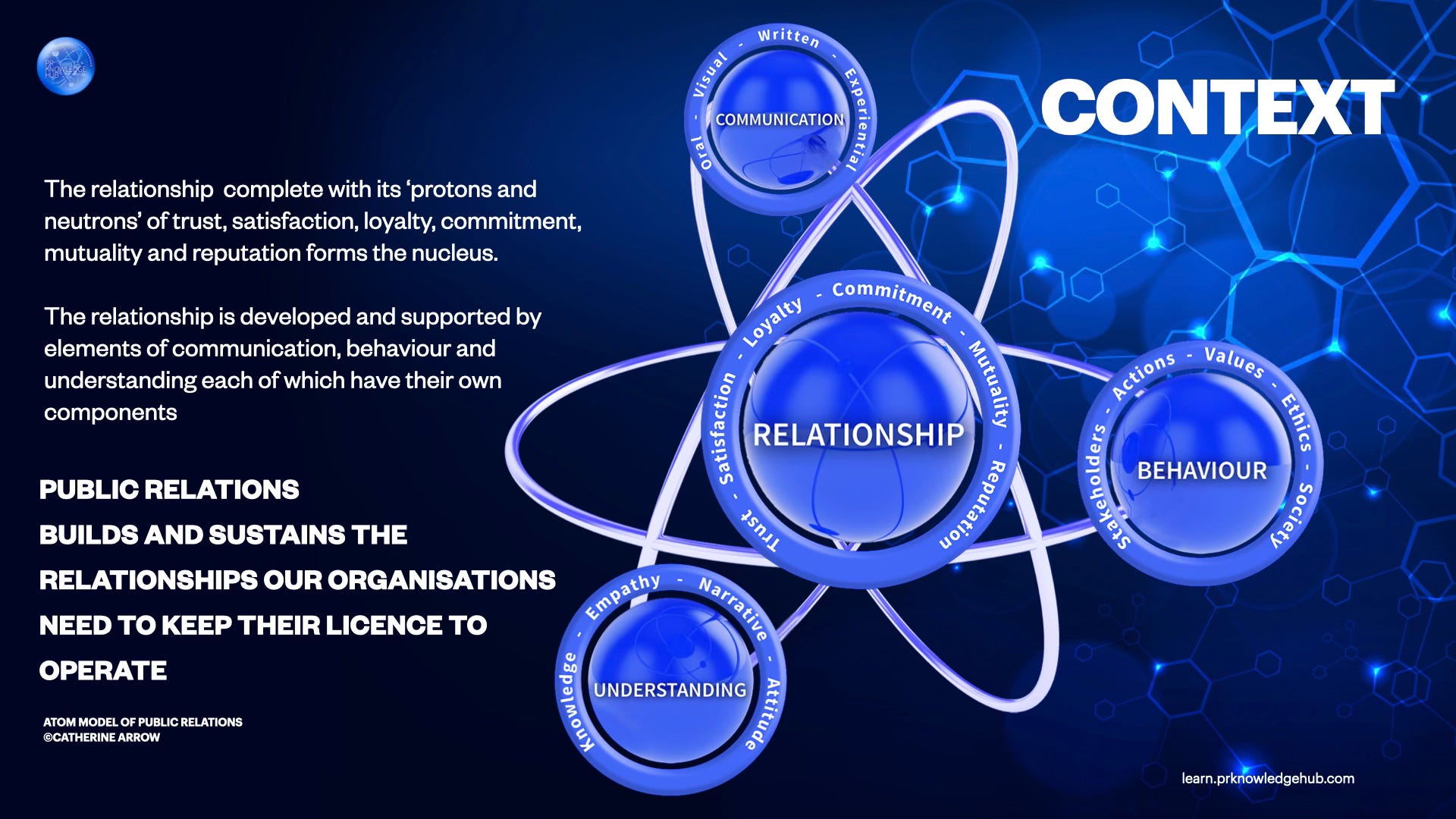
When I devised the PR Atom many years ago it was as a means to demonstrate - or at least visualise - the scope of what we do and how everything we undertake is driven by the relationship. It is not a method or a model for campaign development. It’s not designed to generate quick wins or act as a substitute for reflection. It is, instead, a structural model - a way to see the shape of the practice and its philosophical foundation. A way to hold complexity without confusion. A model that allows us to always start with the relationship.
I chose the name - PR Atom - quite deliberately. Like an atom, it is indivisible in practice even if we break it down in theory. Its parts are distinct but interdependent. Each element affects the others. Change one and you change the whole. Try to split it and you’ll face an explosion of confusion, damage and destruction.
Let’s look at it layer by layer.
The Core: The Relationship
At the very centre is the relationship. This is the nucleus, the centre of gravity, the organising principle.
Every other element of public relations practice orbits this core. Without it, there is no meaningful work to be done. A relationship in this context is not simply a connection or contact. It is a dynamic, evolving interaction between people, groups organisations or communities, supported by all the other elements.
Crucially, a relationship cannot be one-sided. It cannot be a means to an end. It cannot be simply instrumental. If the work of public relations becomes solely extractive - designed only to get what the organisation wants - it may involve communication but it is no longer relational.
This model demands that we regard the relationship as real - something that must be nurtured, respected and examined.
Surrounding the Core: The Six Conditions of Relationship
Encircling the relationship are six interlinked conditions. These are essential and five of them were identified back in 1999 by Grunig and Hon. I add reputation into the mix because without a good reputation people are unlikely to want to have a relationship with you plus a good reputation may well be the starting point for the initial dialogue. These components determine whether the relationship is viable, whether it can endure and whether it serves the purposes it is said to serve, which for the most part is building and sustaining the relationships we need to maintain our licence to operate, be that social, economic, environment or political.
We start with trust - the belief that the other party is honest, competent and will act in good faith. Without trust, no relationship can grow. It is slow to build, quick to lose and harder still to restore. It is not a given; it is a choice made over time.
Next, mutuality – the recognition that the relationship must be reciprocal, not exploitative. Both parties are affected. Both contribute. Both matter. Mutuality does not mean equality of power, but it does require awareness of and respect for the asymmetries involved.
Commitment – the willingness to sustain the relationship, even through challenges. It implies continuity, not convenience. Commitment is not just verbal - it is demonstrated through consistent action and follow-through.
Loyalty – loyalty here is not blind allegiance, but the inclination to remain in relationship even when presented with alternatives. It reflects emotional investment and a sense of shared interest. It grows from consistent commitment and authentic connection.
Satisfaction – this is the perception that the relationship is beneficial, worthwhile and fair. It does not mean perfection. It means that the experience of the relationship meets a baseline of expectation and preferably, exceeds it.
Reputation – not just what others say, but the sum of experiences, expectations and expressions surrounding the relationship. It is a social reality, co-created through actions and interpretations over time.
These six elements form the immediate relational field. They are not always visible but they are always present - or absent. They can be measured in ways that go far beyond sentiment or superficial engagement metrics. They can be tracked, tested and tended to over time. They are, in effect, the ecosystem that sustains the relationship.
The Electrons: Communication, Understanding and Behaviour
Beyond the nucleus of relationship lie the three electrons - communication, behaviour and understanding.
Communication (in all four forms). This is the area that practitioners are most familiar with because in all its forms communication is the area that is the most visible and most frequent form public relations practice. You can't have a good relationship without excellence in communication and in this electron we include all four forms – oral written visual and experiential. We've mostly been associated in the past with written communication but in today's and tomorrow's world experiential communication will be perhaps the most frequently used channel, supported and augmented by artificial intelligence and other technologies. The experience of our interactions, the experience of the relationship will be communicated in this way. Communication is the visible layer of relational intent - it expresses, informs, invites or excludes. It creates meaning and acts as the connection point, the pathway if you like, between each part of the atom and that means tone timing texture and truthfulness are imperative if those connections are to remain intact.
Behaviour is the next electron and this is the true test of the relationship. Organisations reveal their priorities not through their words but through their actions. So when we consider this electron we must consider our ethical behaviours, the way that we treat stakeholders, communities of interest, our stake-seekers as Robert Heath describes them, and others with whom we interact. Do we hold true to the values that we articulated and publicise or do we cave at the slightest hint of political pressure? And can we answer, honestly and with integrity, the question: “ is this the right thing to do?”
Understanding is that last electron and often overlooked because we believe – falsely – that simply by sending stuff out we have communicated with others and therefore they must have an innate understanding of who we are what we do. But that sadly is not the case. When we think about understanding we have to realise that it includes the knowledge that we share, the stories – narratives – that support who we are and give meaning to our intent and purpose. Are we suitably empathetic in the true sense of the word? Or do the attitude that surround us reflect selfish organisational behaviours or an arrogant approach to those we are supposed to be serving one way or another.
These three electrons are interconnected and dynamic. They influence the health of the relationship directly. An organisation might communicate brilliantly but behave poorly and the relationship will suffer. Conversely, an organisation may be relatively quiet but act with integrity and build trust through its deeds.
In practice, these spheres are where most practitioners operate day-to-day - that’s where (and why) you often see the fragmentation of our practice as people occupy their own corner of the universe not necessarily acknowledging that there's life in other spaces and places. And, if there is acknowledgement they fail to see that it's connected with their own activity and involvement.
The siloes of practice are often removed from the relational core and so our activity becomes disjointed, it becomes performative and we find ourselves in that interesting backwater where people believe that we can't do very practical things like measuring evaluate the value of the work that we do. Reorienting towards the PR Atom allows practitioners to align what they do with why they do it.
But we're not finished - not quite yet. There's another layer.
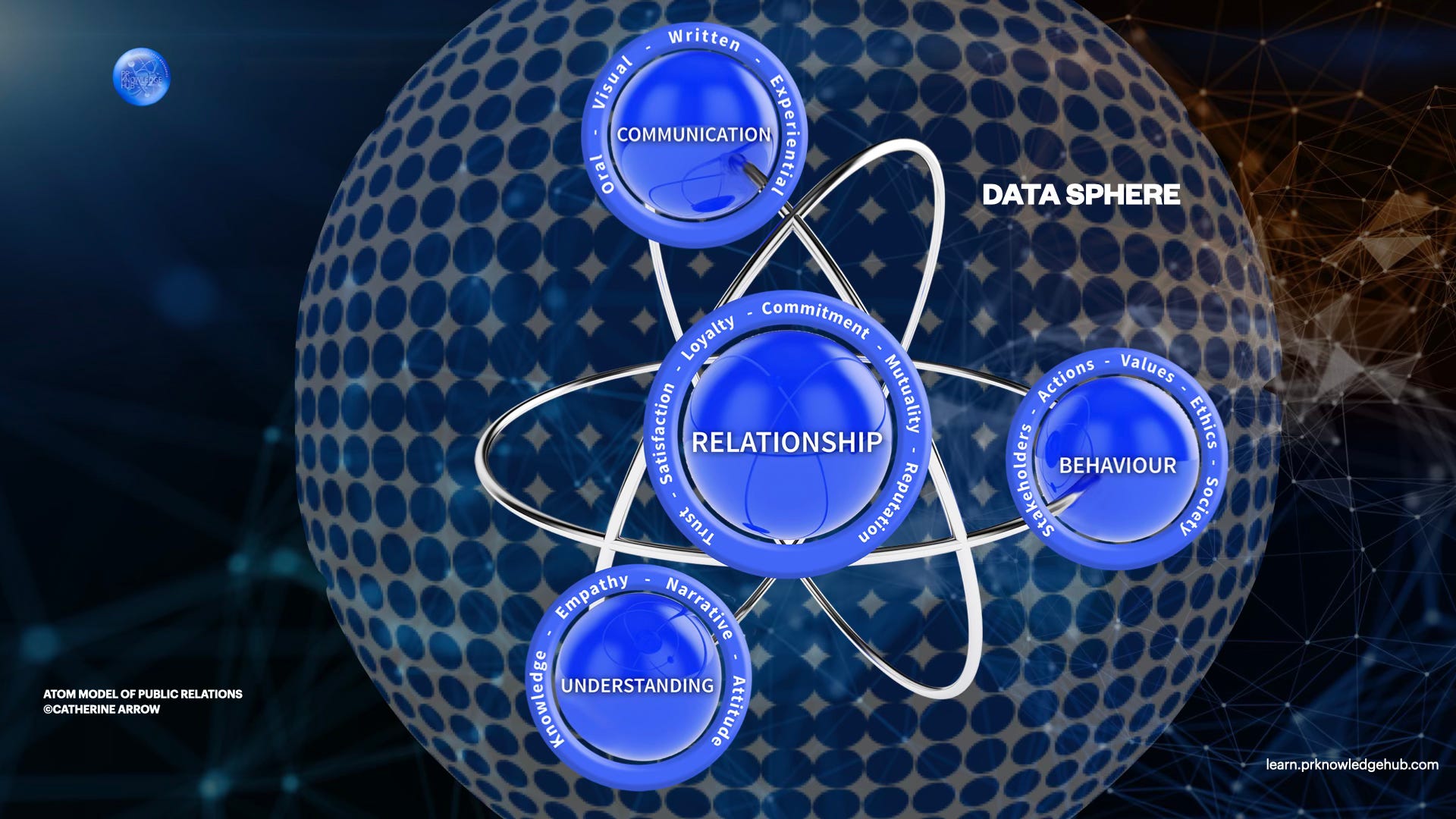
For years I have added data as the final electron but in researching atoms, I realised that in fact data isn't another electron it's the electron cloud as data is the backdrop to absolutely everything that we do. It affects the relationship, it affects our communication, it alters and influences behaviours and without doubt it can either support or undermine understanding to a critical degree. So when we think about data this is the electron cloud present everywhere, shaping trajectory and interpretation but hard to pin down. It represents what's recorded inferred, analysed and circulated around the relationship and its expressions. Data influences behaviour in response, for example, to algorithmic recommendations. It carries traces of the relationship along with it in terms of sentiment and digital presence and, depending on how it's processed and interpreted, will certainly affect understanding.
All of this sits in the orbital cloud, the contextual shell of ethics, culture and systems. This is the outmost layer of the PR Atom and here we will find additional ethical context. What is permitted? What is right? What principles are guiding practice?
Swirling through that we have cultural context, setting the mood for everything that follows. What values, assumptions and social norms shape the interaction? Are those values acknowledged - or imposed?
Then we have systemic context. What institutional, technological or structural forces are at play? How are they influencing the ability to relate, respond or repair?
The outer sphere is not an afterthought. It affects everything inside. In environments of fear or inequality, trust struggles to grow. In cultures of control, mutuality is undermined. In systems shaped by surveillance, behaviour may be shaped by optics rather than values. Understanding this layer is critical to practising public relations with integrity and awareness. The relationship may be central - but it is never separate from its setting.
Seeing the Whole
Throughout my entire career, one of the most challenging aspects of practice has been getting people to see the whole - to understand the totality of the work that we do and the reasons why we do it. The history and roots of practice have led to people working on the fringes, frustrated that they don't have that voice at the 'top table’ and yet if practitioners stopped to look at the whole they would have found their voice far sooner. My real concern is that having reduced many aspects of work to the tactical, practitioners will find themselves being thrown scraps from the table or banished from the dining room completely, replaced and automated. This would be absolutely disastrous for organisational relationships, so we need to get on with proving the value of what we do before it's too late and we're locked outside the gate.
Stepping back then we can look at the whole atom, a framework, a model continually in motion and a way of thinking. A way of seeing. A way to focus on what matters.
When you centre - but don’t isolate - the relationship, you begin to see everything else differently. You see trust not as a brand asset but as a living exchange. You see communication not as control but as connection. You see behaviour not as a policy checklist but as a signal of intent. You see ethics not as risk mitigation but as relational care. And in the chaos and uncertainty that forms a dominant orbital cloud at the time of writing, the PR Atom can act as a compass, helping us to navigate through the fog of complexity and stay on course.
Relationship Matters
As we know we are busy building and maintaining relationships necessary for a licence to operate. We speak frequently about "building relationships”. It's mentioned in plans proposals and performance measures but we don't always stop to ask what relationship is made of, or what it wold require to survive or whether we've actually done anything to improve that relationship and in doing so helped our organisations achieve their strategic outcomes.
So my next field notes take a look at the six components and what they mean and why they're necessary for good relationships.
The six - trust, mutuality, commitment, loyalty, satisfaction and reputation - are not arbitrary. They are the conditions that must be present if the relationship at the heart of public relations is to be genuine, sustainable and worthwhile. Without them, the relationship is thin, one-sided or brittle. With them, it has depth, resilience and moral weight.
These six elements are not linear stages or steps. They interact. They evolve. Sometimes one breaks down and must be repaired before the others can hold. Sometimes one compensates for the temporary absence of another. Understanding them as living conditions - not checkboxes - allows us to move from abstraction to application.

When I was a young girl I would go with my parents to the big town down the road and I loved stopping in the lighting department of the only department store that was near us. It was a delight of sparkling chandeliers, glimmering crystals and, in my favourite spot, was a lava lamp. I would watch the spheres rise and fall, rise and fall and that lava lamp has long been my ‘go to’ analogy when it comes to relationships, stakeholder mapping and identification, community engagement, internal relations and, well, all aspects of the work that we do.
In this instance, when we are considering the six components of the relationship we will need to prioritise them. For example, not every group that we interact with will need levels of satisfaction improving. Our communities may be loyal but they may not trust us. They may be committed but have doubts about our reputation because they've witnessed our actions in play. There may be a power imbalance, and while some relationships can accept that power balance as appropriate, if there is no mutual benefit or no consideration of the other parties, that too will cause problems. So don't think of these components as static, because like my lava lamp spheres, they rise and fall, bubbling to the surface, sometimes intertwining with each other – and when that happens, look out as you've probably got a crisis on your hands.
The following field notes will look at each of the components in turn - I hope you’re sitting comfortably.